
Collin County's Three-Day Release Report
The Collin County Sheriff does not publish a unique static page called a 72-hour list. Instead, the official Arrests & Releases generator has a slider for one through seven prior days. Set it to three. The generated Excel workbook then covers three complete calendar days, beginning at midnight on the oldest day and ending at 11:59:59 p.m. yesterday.
This distinction keeps the result accurate. It is the county's closest official equivalent to a 72-hour report, but it is not the 72 hours immediately preceding a search. A person released today may appear in the rolling inmate lookup before appearing in the next completed-day workbook.
Run Collin County's Three-Day Export
The workbook is created live from the selected date range and downloads without a fee. It has separate arrest and release sheets. Use the release sheet for an exit event rather than assuming every person in the file was released.
- Open the sheriff Store Front report generator.
- Move the prior-days slider to three and read the displayed start and end dates.
- Select “Create Inmate Arrests and Releases Report” and open the downloaded workbook.
- Choose the Inmate Releases sheet, then search the person's full name or SO number.
- Compare release date, time, type, offense, and bond fields with the known case.
- Check the court docket or receiving agency when the release type suggests transfer or another unresolved custody path.
For a release processed today, use the county lookup that includes current inmates and releases within the past 24 hours. The 24-Hour Releases route explains that rolling view and its overlap with the one-day export.
Collin County Three-Day Release Fields
The three-day setting changes the dates, not the workbook structure. A verified county download contained the following release columns. They make the export more useful than a bare roster, yet no single field should be read without context.
| Field | Use |
|---|---|
| SO number | Matches the sheriff's identity for the confinement episode. |
| Inmate name and race | Helps distinguish records, though neither should stand alone. |
| Release date and time | Shows the jail's recorded exit processing. |
| Release type | Identifies the reported reason or route out. |
| Offense description | Connects the row to a charge description. |
| Bond type and amount | Shows bond details when release involved a bond. |
| Bondsman name | Appears when relevant to the reported bond. |
The workbook does not contain an embedded booking image. It also does not promise that every possible release category will appear every day. Read the actual row rather than treating example types as a complete code list.
Weekend Collin County Release Checks
A multi-day range is valuable after weekends and holidays because it reduces the chance that a completed calendar day was skipped. Still, it does not eliminate timing gaps. The export is built live but only through yesterday. No official minute-level synchronization promise was found.
Suppose a search is run Monday afternoon. A three-day setting ordinarily spans Friday, Saturday, and Sunday. A person released Monday morning may instead be in the rolling 24-hour lookup. Running both official channels keeps their different clocks visible.
Court orders and bond actions can also precede physical processing. A docket may show the legal authority while the release sheet supplies the later exit time. Holidays, other holds, and transfers can affect the sequence, so the court event is not a substitute for the sheriff's release entry.
A workbook generated on Tuesday shifts the three completed days to Saturday, Sunday, and Monday. It should not be described as the same weekend file saved on Monday. Record the displayed beginning and ending dates when preserving a result, especially if a later request asks the sheriff to locate the same confinement episode.
Note: Always read the dates shown by the generator rather than counting backward from the current hour.
Why Collin County Uses Two Windows
Collin County's dual structure is distinctive. The inmate-information landing page describes a lookup for people in custody and those released in the past 24 hours. The sheriff Store Front provides a historical export for one through seven completed prior days. The two channels overlap, but they are not duplicates.
| Official channel | Best use | Limit |
|---|---|---|
| Inmate lookup | A release today or within the immediate prior 24 hours | Short display window and mixed current/recent population |
| Three-day workbook | Several completed days, including weekend catch-up | Ends yesterday and requires downloading Excel |
| Seven-day workbook | Maximum published export horizon | Not evidence that underlying records expire |
The current roster is not a durable released-person archive. Absence can reflect release, transfer, a spelling mismatch, another custodian, or update timing. A positive release row plus a court disposition is stronger than absence alone.
Classify Collin County Release Results
Release types can include personal recognizance, served time, surety bond, bond with conditions, probation, and release to immigration. These examples came from a live diagnostic workbook and are not a promise that every file uses the same set.
- Community release
- An exit such as bond or completed jail time that returns the person outside physical custody, subject to any lawful conditions.
- Transfer
- A change from the sheriff to TDCJ, another jail, federal authorities, or immigration custody.
- Probation
- Court-ordered community supervision, distinct from parole after a state-prison sentence.
- Detainer
- A request or authority that can cause another agency to take custody.
A transfer row must be followed into the next system. Search TDCJ for state-prison custody, BOP for a sentenced federal prisoner, or ICE only when immigration custody is actually indicated. Neither TDCJ nor BOP proves release from the county jail unless the custody path connects the records.
Bond fields need similar care. A bond amount and bondsman can explain how the person left physical custody, but the criminal case continues until the court resolves it. Served time describes the custodial result recorded for that matter. Probation describes court-ordered community supervision, not a finding that every charge vanished. The lasting docket supplies the disposition and any later order.
The release workbook can also show an immigration handoff. That row identifies the sheriff's exit route rather than the final outcome of immigration custody. The ICE locator is relevant only after such a transfer is supported. A blank county roster and a missing ICE result still do not establish a return to the community.
Beyond Collin County's Seven Days
Seven days is the public generator's maximum range. It is not the sheriff's stated retention period. Older booking and release information may remain available through an open-record request under the Texas Public Information Act. Ask for an existing record and provide the full name, jailing date, SO number, case number, and specific release fields when available.
The sheriff's open-record route accepts online requests and mail or in-person submissions. The court record is another durable source. It can establish bond action, dismissal, judgment, sentence, time-served language, or later orders, although it may not state the minute the jail completed release.
Collin County routes different records to different custodians. The sheriff maintains the inmate and physical-release material. The District Clerk is the custodian for felony district-court records, while the County Clerk handles misdemeanor County Court at Law records. A police arrest record from a municipal agency belongs with that city department even when the charge later proceeds in a Collin County court.
VINE adds participating-agency custody status and notifications. It is useful for a named person but does not replace the official release record. A former TDCJ episode belongs in TDCJ incarceration-history channels, not in the county three-day workbook. TDCJ's active inmate search is for state custody and projected information, not a complete archive of every former county detainee.
See Collin County's Day Slider
The county's official report screen shows the one-to-seven-day slider and the exact date interval before the workbook is generated. The date text is essential around month changes, holidays, and weekends because it identifies the actual span without guesswork. The same screen creates both the one-day and three-day exports.
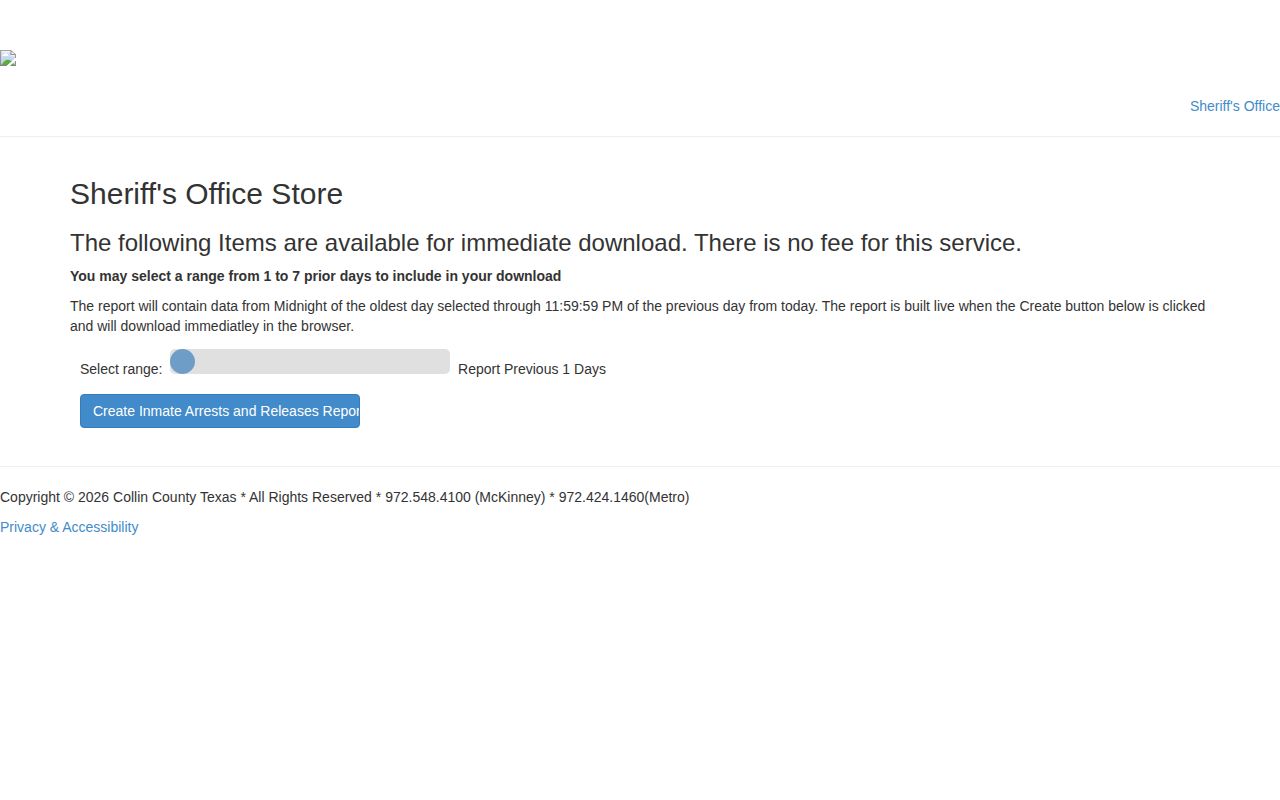
Set the control to three for the 72-hour analogue, then verify that the displayed dates match the completed days needed. Open the Inmate Releases sheet after download. Retain the SO number and release timestamp when asking the sheriff or clerk to reconcile the event with an older court record.
Public Record Search
Sponsored Results