
Parole Decisions and Collin County Release Timing
A parole eligibility date, a Board vote, and a physical release date mark different stages. TDCJ Parole Division identifies cases before initial eligibility and later reviews, while an Institutional Parole Officer prepares the file for a three-person Board panel. Texas ordinary parole review does not use a public calendar of individual offender hearings. Two matching panel votes establish the result, but even a favorable result does not complete the release.
After approval, program completion, a release plan, detainers, and the certificate audit can still affect timing. TDCJ says the Scheduled Release date and Scheduled Release location may appear only after approval and audit. Its Ombudsman guidance describes certificate calculation as commonly taking 14 to 21 business days, while some post-program processing may take four to six weeks. Those are case-specific estimates rather than deadlines, and the scheduled date can change without notice.
Use the BPP review line at (844) 512-0461 for pre-vote status. Once a favorable vote exists, the TDCJ Parole Division release-status line at (512) 406-5202 is the more relevant channel. The locator lines at (936) 295-6371 and (800) 535-0283 address current location and general inmate information. Keeping these channels separate prevents a review code or eligibility date from being reported as the day someone left custody.
Check the Collin County Date Source
The official TDCJ inmate-information page lists the state fields available by request.
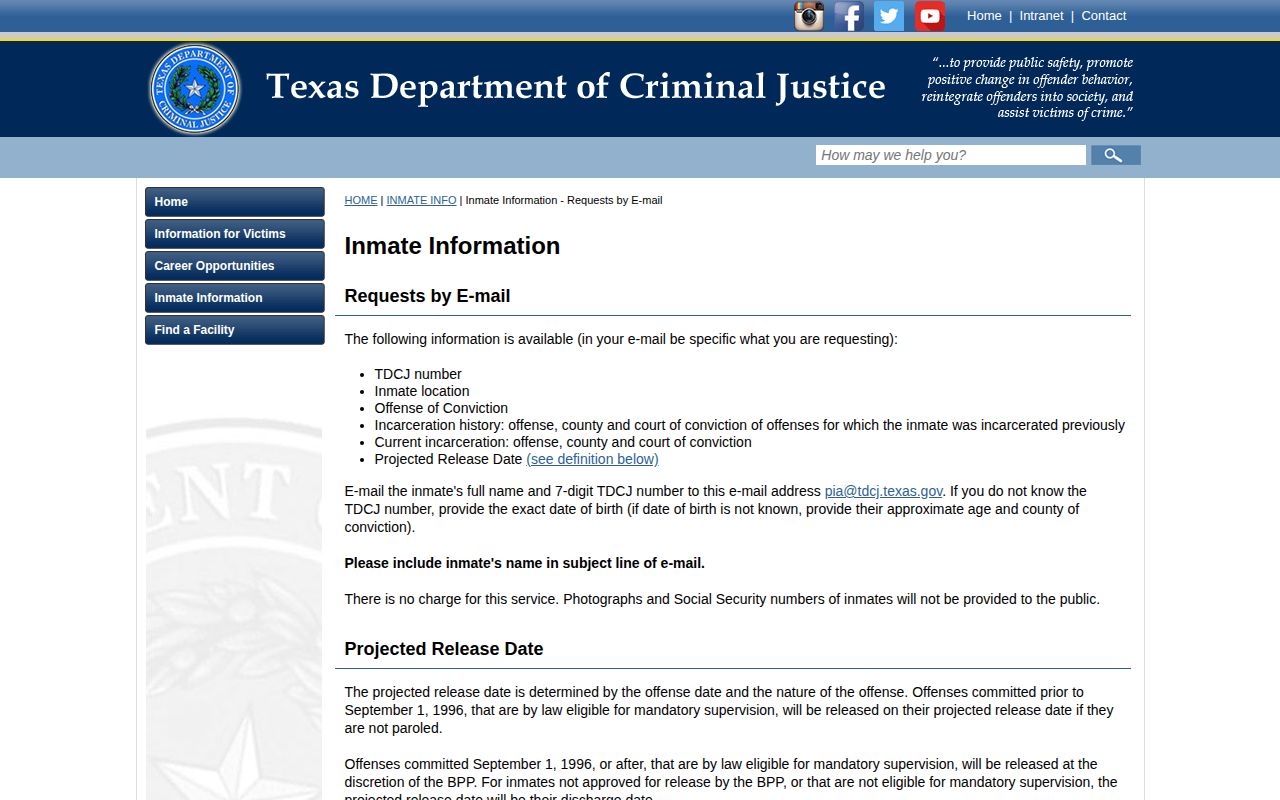
The list shows why a state record must be read as a state-custody record rather than as a Collin County jail release list.
A changed date should prompt a source check, not a guess. Compare the TDCJ result with the sentencing court record and Board decision. If a hold is suspected, ask the custodian whether another agency has a receiving interest that can be disclosed. If a court corrected credit or changed the judgment, obtain the order. These steps separate a legal cause, an administrative update, and display lag.
For a Collin County jail case, request existing fields rather than demanding a new calculation narrative. A narrow request can identify the name, SO number, booking date, case, and maintained sentence or release record. The Public Information Act addresses public information that exists, subject to exceptions; it does not require the sheriff to create a custom forecast.
Collin County Projected and Actual Dates
TDCJ uses the exact public field name Projected Release Date. It is a prospective calculation for a person in state custody, based on the sentence and rules applicable to that person. After a favorable decision and certificate audit, a record can also show a Scheduled Release date and Scheduled Release location. TDCJ warns that even a scheduled date can change without notice, including on that day.
A person awaiting trial in the Collin County Detention Facility does not have a sentence-based projected date. Release may depend on bond, a court order, another agency’s hold, dismissal, or later disposition. A county sentence uses the judgment, sentence start, jail credit, local calculation, holds, and releasing order. TDCJ’s formula must not be copied onto a county-jail sentence.
| Date or status | What it means | Best source |
|---|---|---|
| Projected Release Date | Changeable TDCJ calculation while in state custody | TDCJ search, email, or locator |
| Scheduled Release date | Later planned date after approval and audit | TDCJ release-status channels |
| County calculation | Locally maintained date for a county sentence | Jail record and sentencing court |
| Actual release | Physical processing out of that custodian | Release report or maintained release record |
How to Find a Collin County Release Date
Use the route that matches the custody source. A same-name result from another jail, TDCJ, or a federal system is not a match without identifiers and case context.
- Determine whether the person is in the Collin County jail, a TDCJ unit, federal custody, or another agency’s custody.
- For TDCJ, search by name, TDCJ number, or SID in the official TDCJ Online Inmate Search. Read the location, offense, and Projected Release Date together.
- If the online result is unclear, request the TDCJ fields by email or call the locator at (936) 295-6371 or (800) 535-0283, Monday through Friday, 8 a.m. to 5 p.m.
- For a person in parole review, use the BPP pre-vote line at (844) 512-0461. After a favorable vote, use the Parole Division release-status line at (512) 406-5202.
- For a Collin County sentence, ask the Detention Bureau for the maintained calculation and inspect the judgment and jail-credit entries in the court case.
- After the anticipated date, confirm the actual event in the county release report, TDCJ history, or a written record from the releasing office.
The county inmate lookup includes current inmates and people released within its short 24-hour window. It is useful near the event but is not a long-term release-date archive. The county’s live spreadsheet covers one to seven completed prior days. Older confirmation belongs in a written sheriff record request and the court file.
TDCJ Fields for Collin County Prisoners
TDCJ’s online search covers people in Texas state-prison custody, not a person who was only booked and released by Collin County. Its useful fields include name and identifiers, current location, offense information, and the Projected Release Date. TDCJ’s email information channel can also return TDCJ number, location, conviction, incarceration history, current incarceration, and projected date.
Incarceration history is the better durable state route after custody changes. A favorable BPP vote is not a release timestamp. If approval has occurred, the later Scheduled Release fields and the Parole Division status line are more relevant, but they remain prospective until release is posted.
The BOP Inmate Locator is a separate federal channel. A federal result may say Released or Not in BOP Custody, but that does not prove release from the Collin County jail or entry into the community. Immigration custody uses ICE’s locator. Every system answers only for its own custody.
Note: A transfer from Collin County to TDCJ, another jail, or immigration custody is a custodian change, not community release.
Texas Good Time and Collin County Dates
Texas Government Code Chapter 498 governs good-conduct time, with §§498.003 and 498.004 addressing credit and forfeiture. Credit class, offense date, disciplinary action, and statutory exclusions can matter. TDCJ explains that good time may affect parole or mandatory-supervision eligibility, but it does not shorten every sentence in the same way. Some assaultive offense categories do not use good time in the eligibility computation.
Parole eligibility is principally controlled by Government Code §508.145. It has several formulas tied to offense, date, sentence, and other factors. For listed serious offenses, calendar time without good-conduct credit generally must equal one-half of the sentence or 30 calendar years, whichever is less, subject to the statute’s minima and special subsections. Section 508.149 identifies mandatory-supervision exclusions. Section 508.147 addresses the eligible mandatory-supervision framework.
Eligibility does not mean release will be approved. The judgment, offense date, findings, prior history, statutory category, and TDCJ calculation control the actual case. Reverse-engineering a date from a broad rule can miss exclusions, credits, holds, and Board action.
County Jail Date Calculations in Collin County
No official Collin County public page was found that states a local jail good-time formula. That absence matters. Do not apply TDCJ’s projected-date method to the county jail or promise that a person will leave after a simple fraction of the sentence.
The reliable county calculation begins with the signed judgment and sentence, any recorded jail credit, the sentence start, the jail’s maintained computation, and all active holds or releasing orders. Court records prove what the judge ordered. The jail’s release row proves when physical processing occurred. One source may not contain both facts.
Pretrial detention is different again. Bond can be accepted around the clock at the county facility, but that does not create a fixed release hour. Processing, magistration, conditions, court action, and other holds can intervene. The county does not publish a guaranteed release schedule, so its magistration windows must not be presented as exit times.
Why Collin County Release Dates Change
A future date can move for reasons that arise in the sentence calculation, custody record, parole process, or another case. The reason should be confirmed in the source record rather than inferred from a changed screen.
| Factor | Possible effect | Where to verify |
|---|---|---|
| Credit class or good time | Changes an eligibility or projected computation where legally applicable | TDCJ calculation and Chapter 498 |
| Disciplinary forfeiture | Can remove earned credit; forfeited credit is not simply restored | TDCJ disciplinary and time records |
| Corrected jail credit | Moves the sentence calculation | Judgment, clerk record, and custodian |
| New or vacated sentence | Adds, removes, or changes controlling time | Court docket and amended judgment |
| Detainer or hold | Can send the person to another custodian instead of the community | Releasing office and receiving agency |
| Program requirement | Can delay processing after a favorable vote | BPP and TDCJ status |
| Certificate audit | Can change a planned date before release | TDCJ release-status channel |
| Parole decision | Approval, denial, or later review alters the path | BPP review result |
TDCJ Ombudsman material describes certificate calculation as commonly taking 14 to 21 business days and some post-program processing as taking four to six weeks. Those are case-specific administrative estimates, not deadlines. A scheduled date can still change on the day shown.
Confirm an Actual Collin County Release
When the projected or scheduled date arrives, check the actual custodian again. For Collin County, use the rolling recent-release view or completed-day spreadsheet, then request an older maintained release record if needed. For TDCJ, check the state record and incarceration history. For federal or immigration custody, use the matching federal locator and docket.
A notification can help with timing, but it is not the release record. Texas VINE serves participating county custody feeds. TDCJ IVSS serves state-prison, parole, and mandatory-supervision events. The VINE Inmate Check explains how to match the reporting agency and read an out-of-custody event without mistaking transfer for community release.
Note: Label every future date as projected or scheduled until the responsible custodian records the release as completed.