
Collin County Parole Status Source
The official TDCJ telephone information page separates parole review contacts from post-vote release-status contacts.
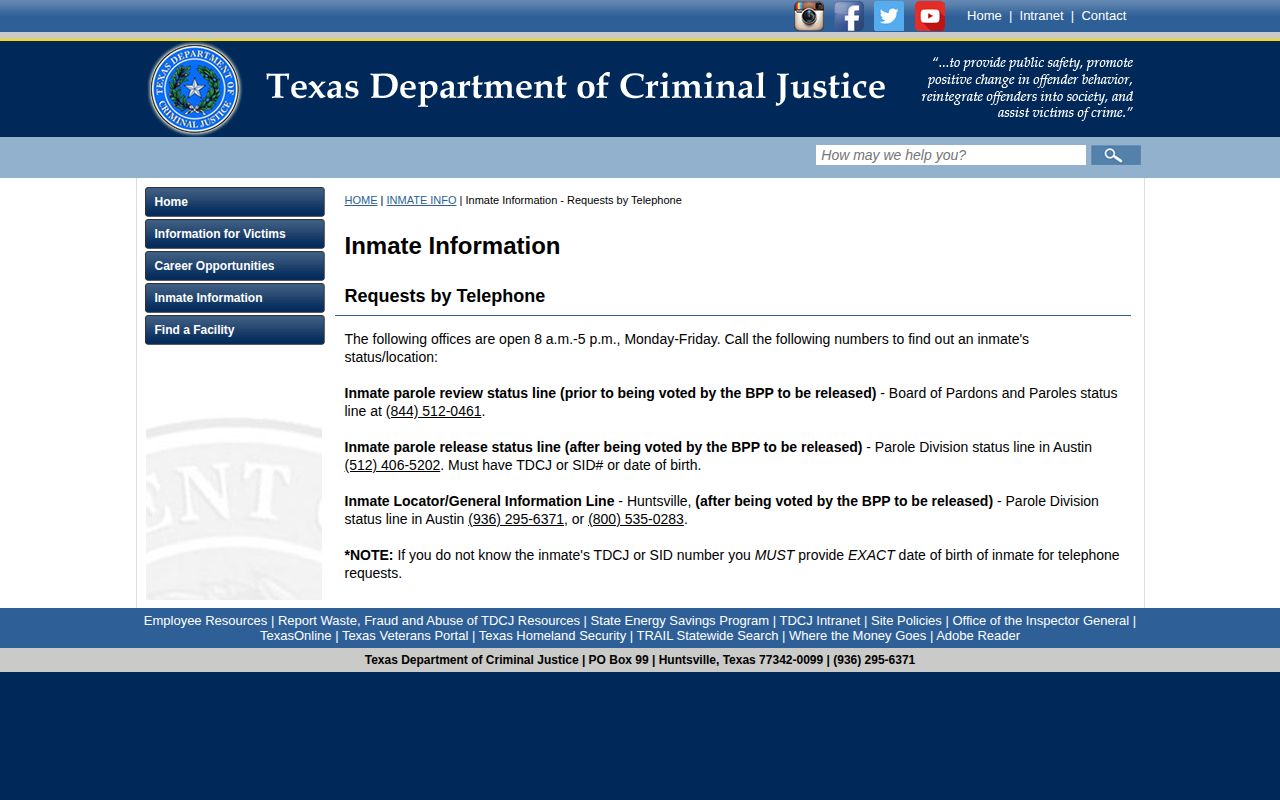
That separation helps prevent a Board review result from being mistaken for a completed exit from state custody.
Collin County Parole and Probation Compared
Parole follows release from a Texas Department of Criminal Justice prison sentence. The Texas Board of Pardons and Paroles makes release decisions, while the TDCJ Parole Division supervises people who are released. Probation is community supervision imposed by a court under Texas Code of Criminal Procedure Chapter 42A. In Collin County, the Community Supervision and Corrections Department, or CSCD, administers that court-ordered supervision.
| Question | Parole or mandatory supervision | Probation or community supervision |
|---|---|---|
| Where it begins | After a TDCJ prison sentence and state release process | By order of a trial court, sometimes instead of prison |
| Decision authority | Texas Board of Pardons and Paroles and applicable law | The sentencing Collin County court |
| Supervising agency | TDCJ Parole Division | Collin County CSCD |
| Best verification record | BPP review result, TDCJ release status, then Parole Division confirmation | Court docket and CSCD confirmation |
| How it ends | Discharge, expiration, or another action under Chapter 508 | Court discharge, expiration, early termination, or revocation under Chapter 42A |
A person released on cash bond, surety bond, personal bond, or pretrial release still has a pending case but is not placed on parole merely by leaving the Collin County Detention Facility. The release record and court docket must be read together.
How to Verify Collin County Post-Release Supervision
Start with the custody system tied to the sentence. This avoids treating a county booking, a state prison commitment, and a federal sentence as though they use one statewide list.
- Identify the case and custodian. Use the Collin County court case for a local charge and TDCJ identifiers for a state prison sentence.
- For a person approaching parole, check the official Board of Pardons and Paroles resources and call the pre-vote line at (844) 512-0461 when needed.
- After an approval vote, call the TDCJ Parole Division release-status line at (512) 406-5202. Approval is not proof that physical release occurred.
- For someone believed to be on state supervision, contact the Parole Division or the Region II office assigned to Collin County.
- For probation, locate the sentencing court and disposition, then contact Collin County CSCD for the assigned office and status that may lawfully be disclosed.
- Record the source and date of the response. Public information may be limited for safety, privacy, or operational reasons.
TDCJ’s public channels serve state prisoners and parole cases. They are not a durable archive for a person who only left the Collin County jail. A federal supervised-release question instead belongs in the federal docket and federal probation system.
Note: A favorable parole vote starts further processing; it does not establish the date or place of the person’s physical exit.
Collin County Supervision Offices
Collin County is assigned to the Dallas II District Parole Office in TDCJ Region II, even though the office name does not include Collin. County probation remains with Collin County CSCD, which maintains multiple local points of contact.
State parole
Dallas II District Parole Office
1135 South Jupiter Road
Garland, TX 75042
(972) 272-9404
County probation
Collin County CSCD
Bloomdale/McKinney: (972) 548-4237 or (972) 548-3660
Community Corrections Facility: (972) 547-5790
Plano: (972) 881-3030
Confirm the current directory before a visit. An office can confirm where a case is routed without providing a private schedule, residence, or itinerary. The aim is to identify the responsible office and the status it is permitted to release.
Texas Parole Review for Collin County Cases
Ordinary Texas parole review is not a public, county-by-county offender hearing. TDCJ Parole Division identifies a file before eligibility, an Institutional Parole Officer prepares a summary, and a three-person panel votes in sequence. Two matching votes settle the result. Quarterly Board meetings concern agency business and are not calendars for individual release decisions.
Government Code §508.145 supplies multiple eligibility formulas based on the offense, date, sentence, and other facts. Section 508.149 lists exclusions from mandatory supervision. Eligibility means a file may be reviewed; it does not compel release. Texas has no single rule requiring every prisoner to serve 85 percent. Applying that shorthand to a Collin County case can produce a false date and a false expectation.
Board codes also require care. FI-1 and FI-2 are favorable vote types, while program-conditioned votes can require more work before exit. NR, SA, and DMS describe denial or later review outcomes. Even after approval, a release plan, program completion, certificate audit, or detainer can delay or prevent the anticipated exit.
Conditions and Violations After Collin County Release
Conditions vary with the order and supervision type. They may address reporting, travel, treatment, fees, contact, testing, or other case-specific duties. The controlling documents are the court order for probation and the certificate or Parole Division record for state supervision. General summaries cannot establish what one person must do.
A suspected violation does not erase the earlier release event. It can lead to an investigation, warrant, hearing, changed conditions, an intermediate placement, or revocation and return to custody. A revocation hearing is separate from the original parole review. VINELink may send offered custody or transfer alerts, while TDCJ IVSS handles state-prison, parole, and mandatory-supervision events. Neither notification service replaces the agency record.
Collin County Warrant Search Limits
Collin County links an Active Warrants search but warns that not every warrant is visible to the public. An empty result cannot prove that a released person has no warrant, no absconder designation, or no supervision issue. The sheriff or relevant constable is the stated verification route when a warrant concern remains.
Likewise, a public warrant result needs context. It can refer to a later event and does not change what an earlier jail release record says. Match the name and case, confirm with the issuing authority, and avoid treating a same-name result as a certain identification.
How Collin County Probation Starts
Collin County CSCD says supervision normally begins with a meeting immediately after sentencing. Staff review the court’s conditions and assign the person to a field office. That local start differs from parole, where TDCJ and BPP processes occur around a state prison sentence.
The court docket is the durable source for the order, later modifications, and disposition. CSCD administers the order, but the court retains legal authority over probation. A jail release row may show that a physical exit occurred without explaining all conditions that followed.
Property and Medication After Collin County Release
Collin County has two time-sensitive procedures that can matter after custody changes. Property left after transfer to TDCJ may be collected by the designated person from 6 to 9 a.m. daily. The county says unclaimed transfer property is donated after 15 days. This is a transfer-property rule, not a standard parole condition.
A released person seeking qualifying continuing medication must contact jail Medical within 48 hours. Under the county FAQ’s limits, eligible chronic-care or mental-health medication may be issued as a 30-day prescription without refills, excluding controlled and over-the-counter drugs. The person bears pharmacy pickup costs. This procedure supports continuity after release and does not confirm supervision status.
Note: Time-sensitive property and medication procedures come from the jail, while supervision terms come from the court or TDCJ.
When Collin County Supervision Ends
Physical release, the start of supervision, and discharge are separate events. State parole or mandatory supervision can end through discharge or expiration under the sentence and Chapter 508 framework. Probation can end by completion, court discharge, early termination where authorized, or another court action. A new violation process can change that path.
Use the final agency or court record to confirm the end date. A person’s absence from a jail roster proves neither successful discharge nor current compliance. For the underlying county release event and court-record route, the Collin County released-inmate search guide explains the local record chain.